Fill in the details below and our team will get back to you shortly.
Key Benefits of Laser Cladding for Industrial Components
Home » Key Benefits of Laser Cladding for Industrial Components
Industrial components often operate under demanding conditions. Continuous friction, high temperatures, pressure, corrosion, abrasion, and repeated mechanical loads can gradually damage their working surfaces. When this happens, replacing an entire component may not always be the most practical solution. Surface engineering technologies can help restore damaged areas and improve the performance of components.
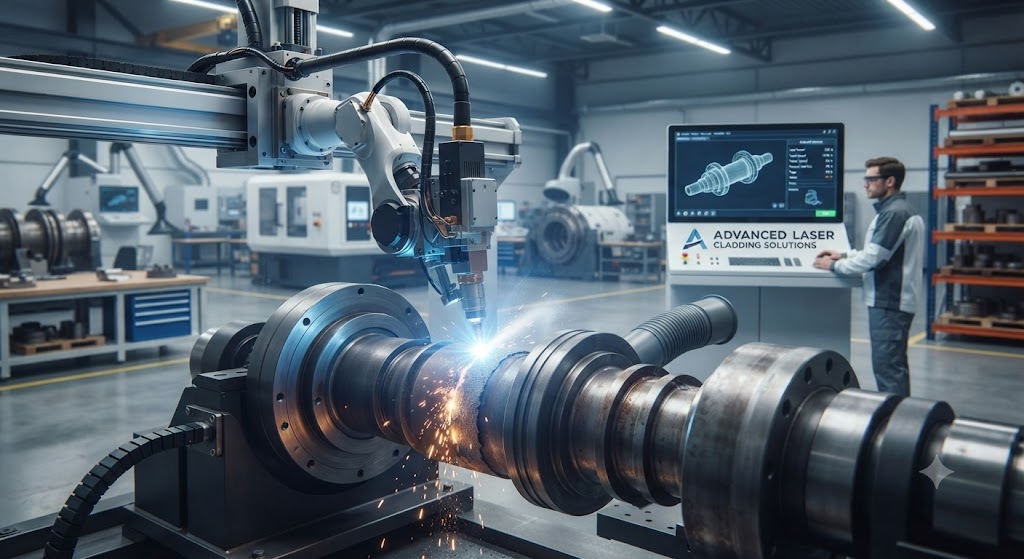
One such technology is laser cladding technology, which uses a focused laser beam to deposit a layer of selected material onto a component surface. The deposited material forms a strong metallurgical bond with the substrate, creating a durable surface designed for specific operating conditions.
For industries that depend on expensive machinery and critical components, this approach can support component repair, surface enhancement, wear protection, and longer service life.
What Is Laser Cladding?
Laser cladding is a surface modification and repair technique in which a concentrated laser beam creates a controlled molten pool on the surface of a component. A filler material, generally in powder or wire form, is introduced into this area and fused with the substrate.
As the molten material cools, it forms a metallurgically bonded layer on the component. Unlike coatings that simply sit on the surface, this bonding mechanism provides strong adhesion between the deposited material and the base metal.
The laser cladding process can be carefully controlled to regulate heat input, deposition characteristics, layer thickness, and the area being treated. This makes it suitable for components where dimensional accuracy and controlled surface modification are important.
Why Is Laser Cladding Used for Industrial Components?
Industrial components can experience different types of surface degradation depending on their operating environment. Abrasion can remove material from moving surfaces, corrosion can attack exposed areas, and high temperatures can affect surface properties.
In many applications, the bulk of the component may still remain structurally usable even when its surface has become damaged or worn.
Laser cladding can address this problem by depositing a suitable material only where it is required. This allows manufacturers and maintenance teams to restore selected areas rather than automatically replacing the entire component.
The approach can be particularly useful for high-value parts where replacement involves significant material, machining, installation, or downtime costs.
1. Improves Wear Resistance
Wear is one of the major causes of industrial component degradation. Components exposed to continuous friction, impact, abrasion, or sliding contact can gradually lose their original dimensions and surface characteristics.
Laser cladding technology can introduce wear-resistant materials onto selected areas of a component. The choice of cladding material depends on factors such as the substrate, operating temperature, type of wear, load conditions, and required surface properties.
By strengthening vulnerable surfaces, the technology can help components withstand demanding operating environments for longer periods.
This can be valuable for components such as shafts, bearing areas, rollers, valves, turbine-related components, and other parts exposed to repeated mechanical stress.
2. Enhances Corrosion Resistance
Corrosion can significantly reduce the working life of industrial components, especially in environments involving moisture, chemicals, aggressive fluids, or elevated temperatures.
A suitable cladding material can provide a protective surface designed to resist the specific environmental conditions faced by the component.
The advantage is that the entire component does not necessarily need to be manufactured from an expensive corrosion-resistant alloy. A compatible protective layer can be deposited on the areas exposed to the harsh environment.
This makes surface engineering an important consideration for industries where corrosion protection directly affects equipment reliability and maintenance requirements.
3. Reduces Heat-Affected Damage
One of the important characteristics of laser-based surface treatment is its localized heat input. The laser concentrates energy in a relatively small area, allowing the process to be controlled more precisely than many conventional welding approaches.
A controlled laser cladding process can therefore help minimize thermal distortion and limit unnecessary heating of the surrounding material.
This is particularly important when working with components that have tight dimensional requirements or when excessive heat could affect the properties of the substrate.
Lower thermal impact can also reduce the amount of corrective machining or post-processing required, depending on the component and application.
4. Provides a Strong Metallurgical Bond
The quality of a surface treatment depends not only on the material deposited but also on how effectively it bonds with the substrate.
Laser cladding creates a metallurgical bond between the deposited material and the base material. This provides a strong connection that can support demanding industrial applications.
The controlled nature of the process also allows the deposited layer to be positioned accurately on specific areas of a component.
For critical parts, this combination of controlled deposition and strong bonding can help achieve a more reliable surface than a process based primarily on mechanical adhesion.
5. Supports Component Repair and Restoration
Replacing a damaged industrial component can involve considerable expense and downtime. In some cases, the damage may be limited to a particular surface or dimensional area while the rest of the component remains usable.
Laser cladding can be used to rebuild selected worn areas and restore dimensions before subsequent finishing or machining, depending on the application.
This makes it useful for refurbishment and remanufacturing applications.
Instead of discarding an entire high-value component because of localized surface damage, manufacturers can evaluate whether the affected area can be restored through an appropriate cladding solution.
6. Enables Precise Material Deposition
Precision is another important benefit of laser-based cladding. The process can be controlled to deposit material only where required rather than covering an entire component unnecessarily.
This selective approach can be useful when only particular surfaces experience wear or corrosion.
The ability to control deposition also provides flexibility when working with complex geometries, edges, or localized damage. The appropriate process parameters and material selection can be determined according to the component's geometry and service conditions.
For applications requiring repeatability, robotic laser cladding can further improve controlled movement and deposition consistency.
7. Helps Extend Component Service Life
The purpose of surface enhancement is not simply to add another layer of material. The objective is to improve the component's ability to withstand its actual operating conditions.
When the appropriate cladding material and process parameters are selected, the treated surface can provide improved resistance against specific forms of wear, corrosion, erosion, or other degradation mechanisms.
As a result, components may remain functional for longer before requiring major repair or replacement.
This can be particularly valuable for machinery where component failure can lead to production interruptions or extensive maintenance work.
8. Supports Cost-Efficient Refurbishment
Industrial components can contain significant amounts of expensive material and may require complex manufacturing processes. Replacing such components frequently can increase maintenance and operating costs.
Laser cladding provides an alternative approach by focusing material deposition on the areas that require repair or protection.
For suitable applications, this can reduce material wastage and support refurbishment rather than complete component replacement.
The economic benefit depends on factors such as component value, damage level, operating conditions, required coating material, machining requirements, and expected service life. Therefore, every application should be evaluated according to its specific technical requirements.
9. Suitable for a Wide Range of Industrial Applications
Laser cladding can be applied to various industrial components and sectors where surface performance is important.
Potential applications include:
Exhaust valves
Hydraulic components
Bearing journals
Heat exchanger components
Turbine components
Rotors
Shafts
Industrial rollers
Wear-prone surfaces
Components requiring corrosion protection
The technology can be considered across industries such as manufacturing, power generation, oil and gas, steel processing, paper and pulp, automotive, and other sectors where machinery operates under demanding conditions.
The appropriate material and process should always be selected according to the component's substrate, operating environment, and required performance.
How Does Robotic Laser Cladding Improve the Process?
Automation can add another level of consistency to surface treatment. Robotic laser cladding combines laser technology with controlled robotic movement, allowing the deposition path to be programmed according to the geometry of the component.
This can be particularly useful when treating complex shapes or when repeatability is important across multiple components.
Robotic movement can help maintain consistent positioning and process paths, while controlled laser parameters support accurate material deposition.
For manufacturers handling repeated repair or coating requirements, automation can therefore contribute to process consistency and production efficiency.
What Should Be Considered Before Choosing Laser Cladding?
Laser cladding is not a universal solution for every component. The suitability of the process depends on several technical factors.
Before selecting laser cladding services, businesses should evaluate:
Base material and material grade
Type and extent of surface damage
Wear mechanism
Corrosion environment
Operating temperature
Component geometry
Required cladding thickness
Required surface properties
Suitable filler material
Dimensional tolerances
Required finishing or machining
Expected operating conditions
A detailed assessment helps determine whether cladding is technically appropriate and which material and process parameters should be used.
How Can Laser Cladding Support Modern Industrial Maintenance?
Modern industrial maintenance increasingly focuses on improving equipment reliability while reducing unnecessary replacement and downtime.
Instead of treating surface damage as a reason to replace an entire component, businesses can evaluate whether localized repair or surface enhancement is possible.
Laser cladding technology fits into this approach by combining repair, refurbishment, and surface protection within a controlled manufacturing process.
Its ability to deposit selected materials on specific areas makes it useful when only the working surface needs to be improved while the underlying component remains suitable for continued use.
Choosing the Right Laser Cladding Partner
The results of any cladding application depend on more than the laser equipment alone. Material selection, component preparation, process parameters, deposition control, inspection, and finishing all influence the final outcome.
When evaluating laser cladding services, businesses should therefore consider the provider's technical capabilities, understanding of the component's operating conditions, material expertise, process control, inspection practices, and experience with similar applications.
A detailed technical assessment before treatment can help determine the right approach for the component and its intended service environment.
Conclusion
Industrial components exposed to wear, corrosion, heat, and mechanical stress require surfaces that can withstand their operating conditions. Laser cladding offers a controlled way to enhance, repair, and protect selected areas of these components without necessarily replacing the entire part.
From improved wear and corrosion resistance to localized repair, reduced thermal impact, precise deposition, and potential service-life extension, the benefits make laser cladding relevant to a wide range of industrial applications.
For businesses evaluating advanced surface engineering solutions, understanding the component, operating environment, material requirements, and expected performance is essential before selecting a process. EWSLLP provides laser cladding solutions designed to support the repair, protection, and performance enhancement of industrial components based on their specific application requirements.