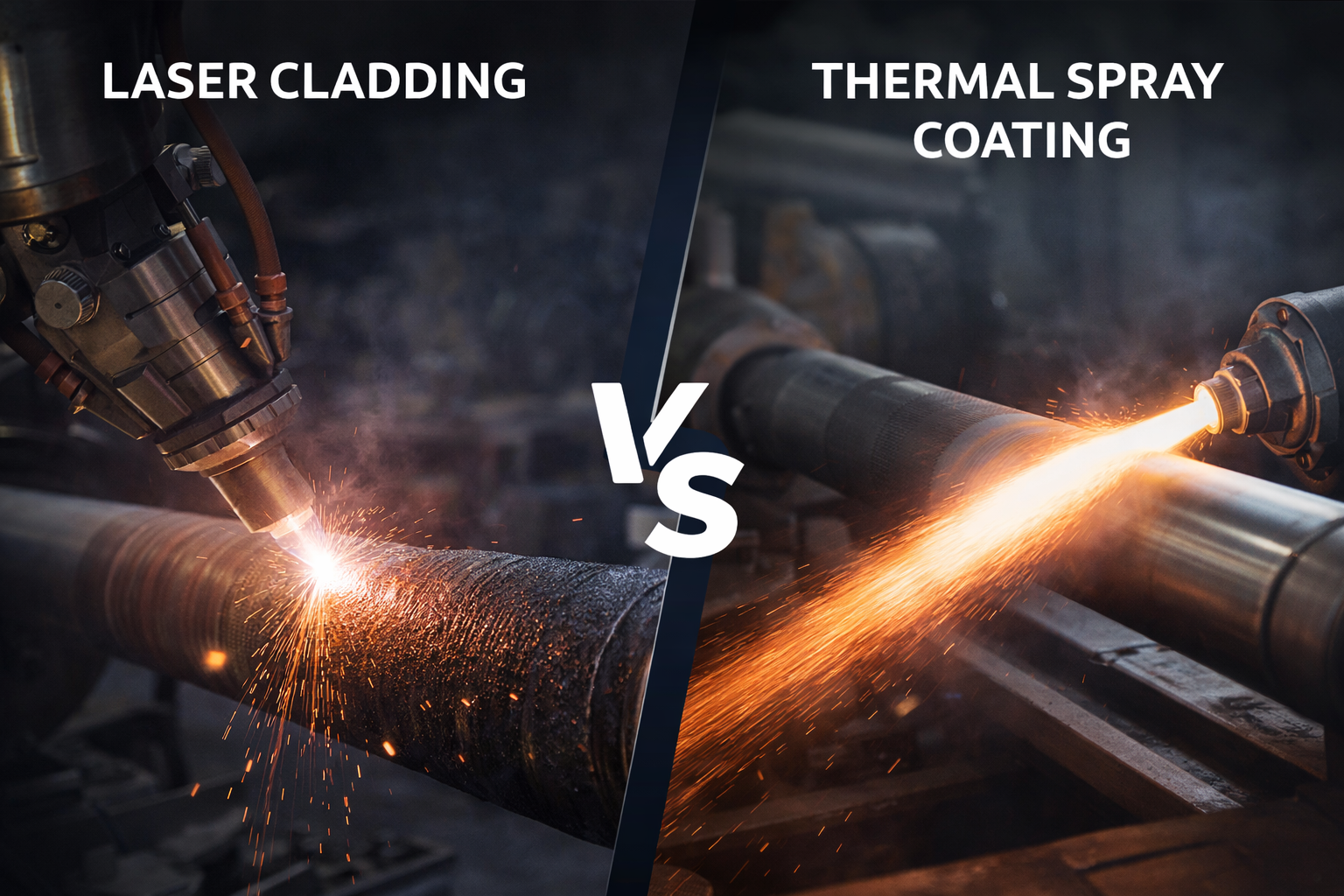
What Is Laser Cladding?
Laser Cladding Technology is a high-precision coating process that uses a focused laser beam to melt a coating material, usually in powder or wire form, onto a metal surface. The laser’s energy fuses the coating and base material, creating a strong metallurgical bond.This method is known for its accuracy and control. Because the heat input is low and localized, there’s very little distortion or dilution in the base metal. The result is a dense, uniform layer with exceptional wear and corrosion resistance.Industries use laser cladding for repairing turbine blades, molds, pump shafts, and high-value components that demand tight dimensional accuracy. For many applications, it’s a preferred method for metal restoration.What Is Thermal Spraying?
Thermal spraying is another surface coating technique but works differently. Instead of melting the base metal, it melts or partially melts the coating material and sprays it onto the surface at high velocity.The molten particles strike the substrate and solidify, forming a strong mechanical bond. Common types include flame spraying, plasma spraying, arc spraying, and HVOF coating. Thermal spray coating services can cover large areas quickly and handle metals, ceramics, and polymers. While it may have some porosity and lower bonding strength than laser cladding, it’s cost-effective and efficient for many industrial uses.Laser Cladding vs Thermal Spraying: Core Differences
| Property | Laser Cladding | Thermal Spraying |
|---|---|---|
| Bond Type | Metallurgical (strong fusion) | Mechanical (particle adhesion) |
| Heat Input | Low and controlled | Higher, can cause substrate stress |
| Coating Density | Very dense, almost no porosity | Moderate density, may contain pores |
| Precision | Excellent, suitable for small areas | Moderate, better for large surfaces |
| Material Efficiency | Minimal waste | More overspray and material loss |
| Distortion Risk | Very low | Slightly higher due to heat exposure |
| Speed & Cost | Slower, higher cost | Faster, more economical |
Performance Comparison
Adhesion and Durability
Laser cladding forms a true metallurgical bond, ensuring superior adhesion and long-term durability even under impact or vibration.Surface Hardness and Density
Controlled heat and fusion deliver smoother, harder, and denser surfaces with minimal porosity.Corrosion and Wear Resistance
Both methods improve corrosion protection, but laser cladding generally provides higher wear resistance due to better coating integrity.Coverage and Speed
Thermal spraying covers large or complex parts faster, ideal for boilers, pipes, or housings. Facilities using Thermal Spray Coating India solutions often choose it for rapid restoration.Choosing the Right Technique
If your focus is precision, minimal heat impact, and extended service life, laser cladding is the best choice. It’s ideal for aerospace, tooling, and critical components operating in harsh environments.If you need quick restoration and large surface coverage at lower cost, thermal spraying is often the better fit. It’s widely used for rollers, pumps, and structural components that experience wear but don’t require tight tolerances.FAQs
Which is better: laser cladding or thermal spraying?+
Laser cladding is ideal for high-precision repairs and strong metallurgical bonding, while thermal spraying is better for large-area coverage and cost-effective restoration. The choice depends on component value, tolerance, and operating conditions.
Is laser cladding stronger than thermal spray coating?+
Yes. Laser cladding forms a metallurgical bond with the base metal, making it stronger and more durable than mechanical thermal spray coatings.
What industries commonly use laser cladding?+
Aerospace, power generation, tooling, oil & gas, and heavy engineering industries use laser cladding where precision, wear resistance, and minimal heat distortion are critical.
Why is thermal spraying preferred for large components?+
Thermal spraying is faster, economical, and suitable for coating large or complex surfaces such as rollers, pipes, boilers, and structural parts.
Does laser cladding cause heat damage?+
No. Laser cladding uses controlled, localized heat input, resulting in minimal distortion or impact on the base material.